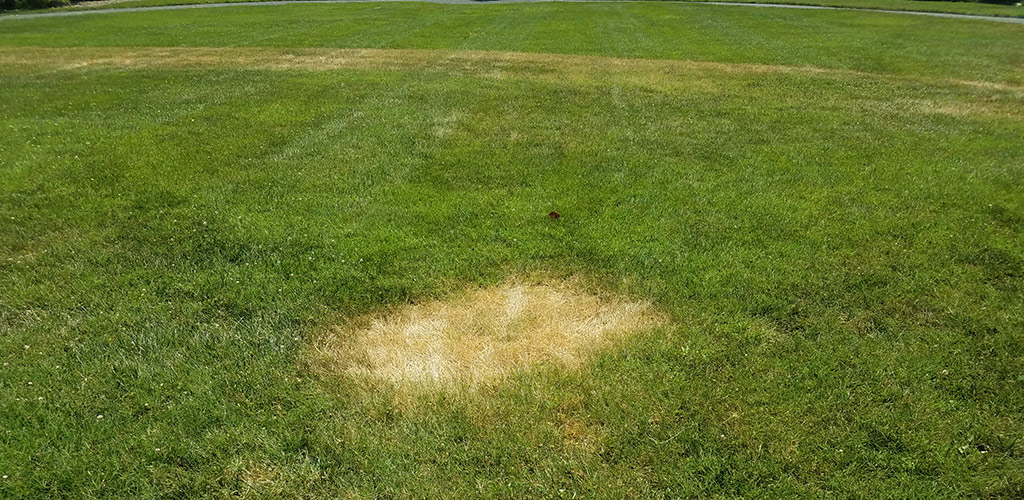
You’ve done everything right this spring. The cut down went well, the lawn greened up on schedule, fertilization happened at the right time, and mowing has been consistent. Then one morning you walk outside and notice a large, roughly circular patch of brown, dead-looking grass that wasn’t there a few days ago.
That’s brown patch. It’s the most common lawn disease in the Birmingham metro, and May is when conditions start lining up for it to appear. Understanding what triggers it, what it looks like, and how to respond can save you from losing significant sections of turf.
What Is Brown Patch?
Brown patch is a fungal disease caused by Rhizoctonia solani, a soil-borne fungus that’s present in virtually every lawn. It doesn’t cause problems most of the time. But when the right combination of heat, humidity, and moisture occurs, the fungus activates and begins attacking grass blades and leaf sheaths.
In the Birmingham area, brown patch primarily affects:
- Bermuda grass (the most common lawn grass in the metro)
- Zoysia grass (common in Vestavia Hills, Homewood, and parts of Hoover)
- Fescue (particularly vulnerable in shaded areas during warm, humid stretches)
The disease doesn’t typically kill the grass down to the roots in warm-season lawns like Bermuda and Zoysia. It damages the leaf tissue, which causes the brown appearance, but the turf can usually recover once conditions change. In fescue lawns, however, the damage can be more severe because fescue is a cool-season grass already stressed by Birmingham’s warm temperatures.
What Triggers Brown Patch in Birmingham?
Brown patch needs three things to take hold, and May in Birmingham often delivers all of them at once:
Nighttime temperatures above 65°F. This is the threshold. Once overnight lows consistently stay above the mid-60s, the fungus becomes active. In the Birmingham metro, that transition typically happens in mid to late May.
High humidity or prolonged leaf wetness. Morning dew, evening irrigation, and extended periods of cloud cover all keep grass blades wet for longer than normal. The fungus thrives when leaves stay wet for 10 or more hours at a stretch.
Excess nitrogen. Lawns that received heavy nitrogen fertilization in spring are more susceptible. Lush, fast-growing turf gives the fungus more tissue to attack. This is one of the reasons that proper fertilization rates matter so much in the spring program.
When all three of these conditions overlap, brown patch can appear seemingly overnight.
How to Identify Brown Patch
Brown patch has a few distinctive visual characteristics that set it apart from other lawn problems like drought stress, insect damage, or nutrient deficiency.
Circular patches. The most recognizable sign is roughly circular areas of brown or tan grass ranging from a few inches to several feet in diameter. The edges of the patch are often darker or more defined than the center.
Smoke ring border. In early morning, especially when dew is present, you may notice a dark gray or purplish ring at the outer edge of the affected area. This “smoke ring” is the active edge of the fungal infection and is the most reliable diagnostic feature.
Leaf lesions. If you pull a blade of grass from the edge of a patch and look closely, you may see tan-colored lesions with darker brown borders on the leaf blade. The grass pulls easily because the leaf sheath at the base of the blade is already compromised.
Pattern vs. drought. Drought stress tends to affect the entire lawn or large, irregular areas. Brown patch creates distinct circular or semi-circular shapes, often multiple patches scattered across the lawn.
What to Do If You Find Brown Patch
If you identify brown patch in your Birmingham lawn, the most important thing is to adjust your cultural practices before reaching for a fungicide.
Adjust Watering Immediately
This is the single most impactful change. Water early in the morning, ideally before 8:00 AM, so grass blades dry quickly as the day warms. Never water in the evening or at night. Reducing the amount of time leaves stay wet removes one of the three conditions the fungus needs.
Hold Off on Fertilizer
If you were planning a late spring nitrogen application, delay it until the active infection subsides. Additional nitrogen feeds the fungus and makes the problem worse. Once conditions improve and the disease pressure drops, you can resume your normal turf management schedule.
Avoid Mowing Wet Grass
Mowing through damp, infected turf spreads the fungus to healthy areas of the lawn. If brown patch is active, wait until the lawn is dry before mowing. Clean your mower deck after mowing affected areas.
Consider a Fungicide When Necessary
For moderate to severe outbreaks, a fungicide application may be warranted. Products containing azoxystrobin, propiconazole, or myclobutanil are commonly used for brown patch in warm-season lawns. Fungicides work best as a preventive measure or at the very first sign of symptoms. Once the disease has caused visible damage to a large area, fungicide limits further spread but won’t restore the already-damaged turf. The grass will need to regrow from the base.
Preventing Brown Patch Before It Starts
Prevention is more effective than treatment with brown patch. A few adjustments to your spring and early summer routine can significantly reduce the risk:
- Water correctly. Deep, infrequent watering in the morning is the single best preventive practice.
- Fertilize at the right rate. Avoid heavy nitrogen applications, especially late in spring. Follow recommended rates for your grass type.
- Improve air circulation. Trim low branches and thin dense shrub plantings near the lawn to allow air to move across the turf and reduce humidity at the leaf level.
- Maintain proper mowing height. Cutting too low stresses the turf and makes it more susceptible. Follow the recommended heights for your grass type.
- Reduce thatch. A thick thatch layer traps moisture and creates the humid microenvironment brown patch needs. If thatch is more than half an inch thick, it may be time to address it.
Brown Patch vs. Dollar Spot
Birmingham lawns can be affected by both brown patch and dollar spot, and the two are sometimes confused. Here’s how to tell them apart:
Brown patch creates larger circular patches (often 1 to 3 feet in diameter or more), appears when nitrogen levels are high, and thrives in warm, humid conditions with nighttime temps above 65°F.
Dollar spot creates small, silver-dollar-sized spots (2 to 6 inches), appears when nitrogen levels are low, and thrives in lawns that are underfertilized during warm weather.
If your lawn has large circles, the issue is likely brown patch. If you’re seeing scattered small spots, dollar spot is more probable. In some cases, both can be present at the same time.
If You’re on a Steven’s Wack-n-Sack Turf Management Program
For clients enrolled in a turf management program with Steven’s Wack-n-Sack, our team monitors for disease activity during regular property visits. We know the conditions that trigger brown patch in the Birmingham area and can adjust treatment timing, fertilization rates, and watering recommendations to reduce risk. If an active outbreak is identified, we can recommend targeted treatment before the damage spreads across the property.
Catch It Early, Recover Faster
Brown patch is part of managing a warm-season lawn in Birmingham. It shows up when conditions allow it, and the lawns that recover fastest are the ones where it’s caught early and practices are adjusted quickly. Keep an eye on your lawn as overnight temperatures climb into the mid-60s, watch for circular patches that don’t respond to watering, and check for the smoke ring in the early morning.
If you’re seeing damage you can’t explain or want professional monitoring as part of your lawn care plan, Steven’s Wack-n-Sack provides residential and commercial lawn care and turf management across Birmingham, Hoover, Vestavia Hills, Homewood, Alabaster, Pelham, Helena, Chelsea, and the surrounding metro. Contact us to discuss your lawn’s needs.