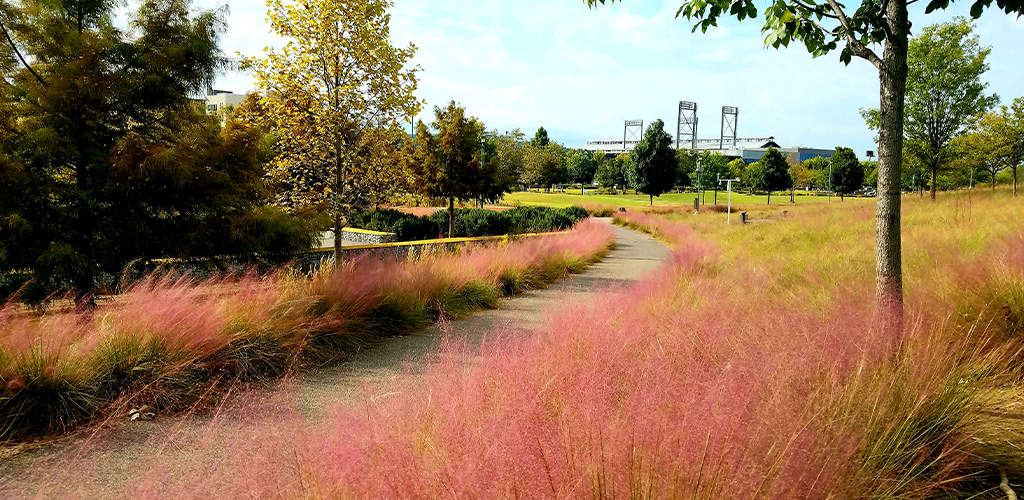
For about eleven months of the year, muhly grass is a perfectly nice green mound that nobody looks at twice. Then late September arrives and it throws up a haze of pink flower stalks so fine and so dense that the whole plant looks like colored smoke.
If you’ve driven past a commercial property or a well-designed front bed in the Birmingham area in October and wondered what that pink cloud was, this is it. Muhlenbergia capillaris, commonly called pink muhly grass or Gulf muhly, and it happens to be native to Alabama.
A Native That Earns Its Spot
Muhly grass grows wild across the Southeast, which means it comes pre-adapted to everything our climate throws at it. Summer heat, humidity, drought stretches, poor soil, and clay. Once established it needs essentially no supplemental water and no fertilizer.
That combination of low input and high visual payoff is rare. Most plants that deliver this much impact want something in return. Muhly grass does not.
It’s also deer resistant, has no meaningful pest or disease problems in this region, and holds structure through winter after the color fades.
What It Looks Like and How Big It Gets
The foliage forms a fine-textured mound roughly 2 to 3 feet tall and about as wide. When the flower stalks come up in fall, the whole plant reaches 3 to 4 feet.
The bloom itself is the point. Individual flowers are tiny, but they’re produced in enormous airy panicles that read as a solid mass of pink or rosy purple from a distance. Peak color in Central Alabama runs from the last week of September through October, and the plumes hold on into November as they fade to a soft tan.
Placement Is Everything
Here is the one thing that separates a muhly grass that looks good from one that stops people in their tracks: plant it where low sun will backlight the blooms.
The flower panicles are translucent. Lit from the front, they look pink. Lit from behind by morning or late afternoon sun, they glow. Western and eastern exposures where the plant sits between the viewer and the low sun produce a completely different effect than the same plant in flat midday light.
Beyond that, the requirements are simple:
- Full sun. Six hours minimum. Bloom production drops sharply in shade.
- Well-drained soil. This is the one thing muhly grass will not tolerate. Wet feet in heavy clay will kill it. On flat, poorly drained ground, plant slightly raised or amend for drainage.
- Mass plantings over single specimens. One muhly grass is pleasant. A drift of seven or nine is what people photograph.
Good spots include slopes, bed borders, along driveways and walkways, and transitional areas between maintained lawn and natural space.
Where It Works on Commercial Properties
Muhly grass is worth considering for commercial landscapes in the Birmingham metro. It’s drought tolerant, needs almost no maintenance during the season, and delivers a seasonal color moment without the labor and cost of an annual changeover.
It performs particularly well in parking lot islands and perimeter beds, which is where most plant material struggles. Heat off the pavement and inconsistent irrigation are exactly the conditions muhly grass shrugs off.
Varieties Worth Knowing
- Straight species (Muhlenbergia capillaris). The standard pink form. Reliable and widely available.
- Regal Mist. A selection with denser, more saturated pink bloom. Common in commercial installations.
- White Cloud. A white-blooming form. Later than the pink and taller, and it pairs well planted alongside it.
- Undaunted (Muhlenbergia reverchonii). A closely related species, more compact and slightly more cold hardy, with a softer pink haze.
Care Through the Year
Almost nothing, with one timing rule that matters.
Do not cut it back in fall. The seed heads carry interest well into winter, and the standing foliage protects the crown through cold weather. Cutting in October removes four months of visual value for no benefit.
Cut back in late winter. February is right for Birmingham. Take it down to 6 to 8 inches before new growth pushes. A single hard cut once a year is the entire maintenance program.
Skip the fertilizer. Feeding produces floppy growth that splits open in the middle. Native soil is fine.
Divide every three or four years. If the center of the clump starts to die out and the plant opens up, lift and divide it in early spring.
Pairing It Out
Muhly grass fills the same late-season gap that American beautyberry does, and the two work well together since the purple berries and pink plumes overlap for several weeks. Follow both with camellias and a bed can carry interest from August straight through winter without a dead stretch.
Fall is also the right window to get it in the ground. If you’re planning bed work this season, Steven’s Wack-n-Sack provides landscaping services for residential and commercial properties across Birmingham, Hoover, Vestavia Hills, Homewood, Alabaster, Pelham, Helena, Chelsea, and the surrounding metro. Contact us to talk through what would work on your property.