Every fall we get calls from homeowners across Birmingham who have spotted something in a tree and want to know how bad it is. Usually it’s a silk nest wrapped around the end of a branch, and usually the answer is that it looks worse than it is.
But not always. Three different pests get lumped together in these conversations, and telling them apart matters, because one of them will kill a plant and the other two mostly won’t. The good news is that identification is easy once you know what separates them.
Fall Webworm
Where the nest sits: At the tips of branches, wrapped around the leaves the caterpillars are feeding on. The nest expands outward as they eat.
When you see it: Late summer through fall. In Central Alabama there are two generations, and the fall one is the conspicuous one.
What it feeds on: Almost anything deciduous. Well over a hundred species, including pecan, hickory, sweetgum, river birch, cherry, persimmon, mulberry, redbud, maple, elm, black walnut, and sourwood. If you have hardwoods in the yard, you’re a candidate.
How worried to be: Not very. By the time fall webworms show up, the tree has already spent the growing season photosynthesizing and storing energy for next spring. Losing some foliage in September and October is close to irrelevant to a healthy, established tree. The damage is cosmetic.
What to do: If the nest is within reach, prune out the branch tip and dispose of it. You can also break the webbing open with a pole, which lets birds and predatory insects get to the caterpillars. If the caterpillars are still small, a Bt product works well. Do not burn nests out of trees. People try it every year and it damages the tree far more than the caterpillars would have.
Eastern Tent Caterpillar
Where the nest sits: In the crotch of the tree, where branches fork away from the trunk. This is the single easiest way to tell it from a webworm. Webworms build at the ends, tent caterpillars build at the joints.
When you see it: Spring, typically February through April in Alabama. If you’re looking at a nest in September, it isn’t this.
What it feeds on: Mainly cherry, crabapple, and plum.
How worried to be: Also not very. Trees defoliated in spring generally push a second flush of leaves and recover. Repeated heavy infestations over several years can weaken a tree, but a single season rarely does lasting harm.
What to do: Remove tents by hand or with a pole in early morning or evening when the caterpillars are inside. Bt works on young larvae.
Bagworms
This is the one that matters.
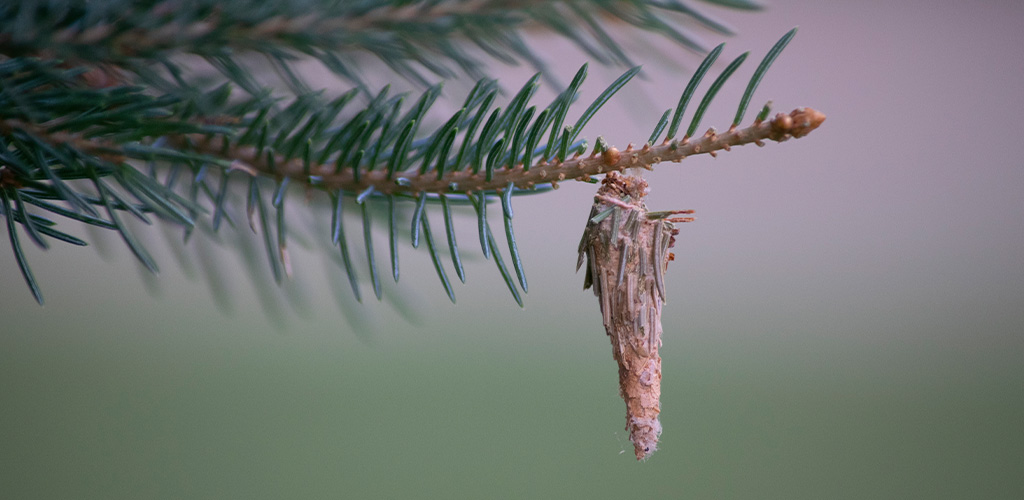
What it looks like: Not a communal nest at all. Bagworms build individual spindle-shaped bags out of silk and bits of the plant they’re eating, so the bag is camouflaged with the host foliage. They hang from branches and are routinely mistaken for small pinecones or seed pods.
When you see it: The bags are visible year round. Larvae feed from roughly late May through August, and the bags they leave behind stay attached through fall and winter.
What it feeds on: Evergreens above all. Leyland cypress, arborvitae, juniper, cedar, and spruce. They’ll also attack deciduous trees, but evergreens are where the real damage happens.
How worried to be: Very. Evergreens cannot regrow foliage the way a deciduous tree can. Once a branch is stripped, it stays bare. A heavy infestation can kill a Leyland cypress in one or two seasons, and given how many are planted as privacy screens throughout Birmingham, Hoover, and the surrounding suburbs, this shows up regularly.
What to do: Fall and winter are actually a productive time to deal with bagworms, because each overwintering female bag holds somewhere between 500 and 1,000 eggs. Hand-picking bags off the plant now and putting them in the trash removes next year’s population before it hatches. For treatment, Bt applied in late spring and early summer while larvae are small is highly effective. Once the larvae mature and seal their bags, sprays stop working.
The Short Version
Nest at the branch tips in fall is a webworm and it’s cosmetic. Nest in the branch fork in spring is a tent caterpillar and it’s cosmetic. Individual bags that look like small pinecones on an evergreen are bagworms, and those need attention.
What to Do This Month
September is a good time to walk your property with this in mind. Prune out webworm nests you can reach and leave the ones you can’t. More importantly, look closely at any Leyland cypress, arborvitae, or juniper on the property. If you see the bags, start picking them off, and make a note to schedule Bt treatment for late spring.
A privacy screen that’s thinning from the bottom or showing bare interior branches is worth a closer inspection before it becomes a replacement project.
If you’d rather have someone else evaluate what’s going on in your trees and shrubs, Steven’s Wack-n-Sack provides landscaping and property maintenance for residential and commercial properties across Birmingham, Hoover, Vestavia Hills, Homewood, Alabaster, Pelham, Helena, Chelsea, and the surrounding metro. Contact us and we’ll take a look.