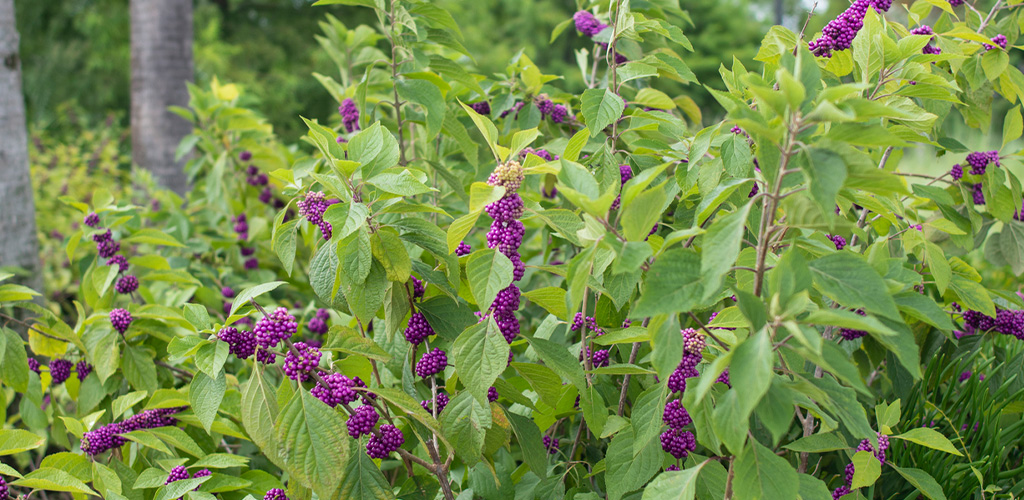
Most of the plants we feature earn their spot with flowers. American beautyberry earns it with fruit. Right now, along woodland edges and fence lines across Central Alabama, this native shrub is producing tight clusters of berries in a purple so saturated it looks artificial the first time you see it.
The blooms in early summer are small and easy to miss. The berries are the whole point, and they arrive in late August and hold through September and October, right when most of the landscape is winding down.
An Alabama Native
American beautyberry (Callicarpa americana) grows wild throughout Alabama and across the Southeast. If you’ve walked a wood line in Shelby or Jefferson County in September, you’ve probably seen it without knowing what it was.
Because it’s native, it asks for very little. It’s adapted to our clay soil, our humidity, our summer heat, and our rainfall patterns. Once established, it handles drought without supplemental irrigation and rarely deals with pest or disease problems. For homeowners who want something interesting that doesn’t require a maintenance routine, that’s a strong combination.
It also feeds wildlife. More than forty bird species eat the berries, and in the Birmingham area you’ll regularly see mockingbirds, cardinals, and thrashers working through a loaded shrub in fall.
What It Looks Like and How Big It Gets
Beautyberry grows 3 to 6 feet tall and roughly as wide, with a loose, arching form. It is not a tight, formal shrub, and trying to shear it into one defeats the purpose. The natural habit is part of the appeal.
The berries form in dense clusters that wrap directly around the stem at each leaf node, which is unusual and part of what makes the plant so recognizable. Leaves are large, coarse, and slightly fuzzy, turning yellow-green before dropping in fall. Once the leaves drop, the berries often remain on bare stems for several more weeks.
Varieties Worth Knowing
- Straight species (Callicarpa americana). The native form with vivid magenta-purple berries. The most reliable performer in Birmingham landscapes and the best choice for naturalized areas.
- Callicarpa americana var. lactea. A white-berried form of the native. Striking in shade and a good contrast planted alongside the purple form.
- Welch’s Pink. A pink-berried selection of the native species. Less common but worth looking for.
You’ll also find Asian species like Callicarpa dichotoma and Callicarpa bodinieri at garden centers. They’re generally more compact and tidier in habit, but they don’t offer the same wildlife value or regional adaptation as the native.
Where to Plant It
Beautyberry is flexible, but a few placements bring out the best of it:
- Woodland edges and tree lines. This is where it grows naturally and where the arching form looks right.
- Partial shade. It tolerates full sun in Birmingham if it gets adequate moisture, but light afternoon shade produces better foliage and heavier fruit set.
- Mixed borders as a back layer. The loose habit works better behind tidier plants than out front on its own.
- Naturalized and low-maintenance areas. Property corners, along fences, or transitional zones between maintained lawn and wooded areas.
Avoid tight foundation plantings and formal beds. It will outgrow the space and look out of place among clipped shrubs.
Care and Pruning
The care list is short, which is most of the appeal.
Water regularly through the first growing season to establish roots. After that, supplemental water is only needed during extended drought.
Fertilizer is generally unnecessary. Native plants in native soil rarely need it, and heavy feeding pushes leggy growth at the expense of fruit.
Mulch with 2 to 3 inches of pine straw or shredded bark to hold moisture and keep the root zone cool.
Pruning is the one thing worth getting right. Beautyberry flowers and fruits on new wood, which means late winter pruning does not cost you berries. If the plant has gotten leggy or oversized, you can cut it back hard, to within a foot of the ground, in February. It will come back vigorously and fruit the same season. This is the opposite of azaleas and gardenias, which set buds on old wood and must be pruned right after they bloom.
A Bridge Into Fall
One of the best things about beautyberry is where it falls on the calendar. Summer annuals are fading by late August. Fall color hasn’t arrived yet. Beautyberry fills that gap with something no other plant in the landscape is doing, and it holds interest for two months.
Pair it with plants that come on later, like camellias or muhly grass, and you can carry a bed from August straight through to winter without a dead stretch.
If you’re thinking about adding native plants to your landscape or want help with bed design, planting, and seasonal maintenance, Steven’s Wack-n-Sack provides landscaping services for residential and commercial properties across Birmingham, Hoover, Vestavia Hills, Homewood, Alabaster, Pelham, Helena, Chelsea, and the surrounding metro. Contact us to talk through what would work on your property.