Irrigation systems rarely get attention in November. The turf is going dormant, the beds need less water, and the system mostly runs on its own. Then a hard freeze comes through, a backflow preventer splits, and someone finds water spraying across the parking lot the next morning.
In Birmingham, this is one of the more preventable winter repairs on a commercial property. It just has to happen before the cold, not after.
How Much Time You Have
The National Weather Service tracks three cold thresholds for Birmingham. On average, the first 36-degree night arrives in late October, the first freeze at 32 degrees around November 10, and the first hard freeze at 28 degrees around November 19. Those are averages. Birmingham has seen 28 degrees as early as the third week of October.
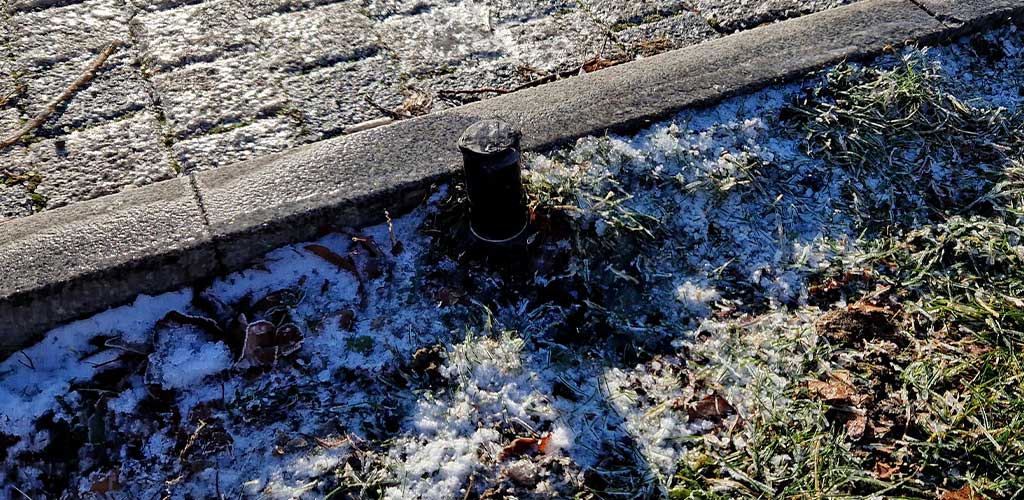
The 28-degree mark matters most for irrigation. A brief dip to 32 rarely damages equipment, but a few hours in the upper 20s can freeze the water sitting inside exposed fittings. Water expands as it freezes, and the brass and PVC parts above ground are the first to crack.
Why Commercial Systems Are More Exposed
Commercial systems carry more of the parts that fail in a freeze:
- Larger backflow assemblies mounted above ground, often in open, wind-exposed spots near the street or parking lot
- More zones and more valves, which means more places for water to sit
- Exposed piping at building walls, risers, and connections that a residential system might not have
- Higher repair costs when something does break, plus the cost of water lost before anyone notices
There’s also a liability angle. We covered it in our post on winter weather planning for commercial properties. A burst fitting near a walkway puts water on pavement, and on a freezing night that becomes a sheet of ice.
The Shutdown Steps
The basics of a proper shutdown:
Turn off the water supply, then switch the controller to off or rain mode so it doesn’t try to run zones against a closed valve.
Drain the backflow preventer and any exposed piping. Water left in above-ground components is what freezes and splits them.
Open manual drain valves to empty the lines and heads. Close them again in spring before the system is recharged.
Insulate everything above ground. Wrap the backflow preventer, the main shutoff, and any exposed pipe. Insulated covers made for backflow assemblies are inexpensive and widely available.
Leave air blowouts to a professional. Compressed-air blowouts can damage a system if they’re done wrong. Too much pressure can crack fittings and heads.
Full Shutdown or Partial?
Many Birmingham commercial properties don’t shut irrigation down completely for the season. Winter here is mild between cold snaps, and newly installed sod, fresh plantings, or fescue areas may still need occasional water during a dry stretch.
If the system will stay active, it still needs protection:
- Keep the backflow preventer insulated all season, not just the night before a freeze
- Watch the forecast and shut off and drain exposed components ahead of any night forecast in the upper 20s or below
- Set the controller so zones don’t run on freezing mornings, when spray onto walks and drives can freeze
A partial approach works, but it depends on someone watching the forecast. A full shutdown takes that risk off the table.
Don’t Forget Backflow Testing
Shutdown season is also a good time to check backflow testing. For much of the metro, the water utility (Central Alabama Water, formerly the Birmingham Water Works Board) requires every customer with a backflow device to have it tested annually by a certified tester from its approved list. Failed devices must be repaired or replaced within 30 days and retested. If your property’s test is due, it’s easier to coordinate before the system goes down for the winter or when it comes back up in spring.
Bringing It Back in Spring
Recharging the system matters as much as shutting it down. Close the drain valves before turning the water back on, bring pressure up slowly, and check every zone for broken heads and leaks before the first regular cycle. Problems caught in March cost far less than problems found in June when the turf starts to brown.
Get It on the Calendar Now
The window between the first frost and the first hard freeze is short, and it’s the busiest stretch of the fall for grounds crews. Properties that schedule shutdown in early November get it done on time. Properties that wait for the forecast are calling around the day before the cold arrives.
Steven’s Wack-n-Sack provides commercial grounds maintenance across Birmingham, Hoover, Vestavia Hills, Homewood, Alabaster, Pelham, Helena, Chelsea, and the surrounding area. Because we handle the whole property, irrigation shutdown happens alongside leaf cleanup, bed work, and winter prep instead of as a separate vendor call. Contact us to schedule your irrigation shutdown before the first hard freeze.