Anyone who was in Birmingham in January 2014 remembers what a little snow and ice can do to a city that isn’t set up for it. That month, overnight lows at the airport stayed at or below freezing for 17 straight nights, one of the longest cold stretches in the National Weather Service’s records for the city. Most winters are nothing like that. But most winters do bring at least one morning when freezing rain glazes the walkways, and properties that didn’t plan for it spend that morning scrambling.
You may be asking, “why are we talking about de-icing and freezing rain in October?” The reason to plan in October is that nobody has time to figure it out once the forecast turns. Ice melt disappears from local shelves, contractors are booked, and the question of who’s responsible for what gets answered in a hurry, or not at all.
Planning ahead is always a good idea, especially for commercial properties. Here are Steven’s Wack-N-Sack’s recommendations on how to plan, and what we can do to help.
Pre-Treat Before the Ice Forms
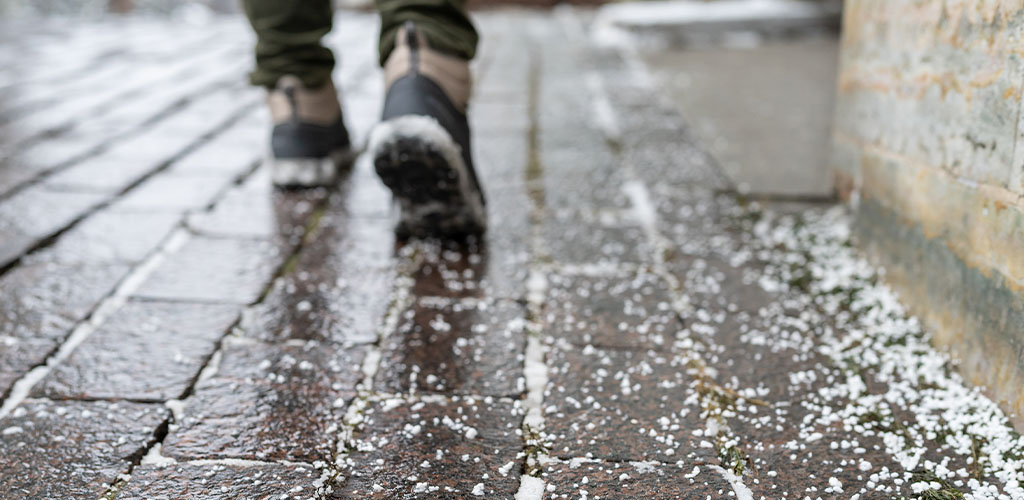
Most winter weather in Birmingham isn’t a foot of snow. It’s a thin glaze of freezing rain or sleet that turns sidewalks, parking lots, and neighborhood roads into skating rinks for a morning or two. Treating that after it forms is slow going, because the ice has already bonded to the pavement.
Spreading de-icer ahead of the event works better. Down before freezing precipitation arrives, it keeps ice from bonding in the first place, so whatever does form breaks up and clears much faster.
That’s the focus of our winter service. Steven’s Wack-n-Sack offers de-icing and snow removal for businesses, HOA communities, and homes across the Birmingham area, with an emphasis on treating properties before the ice shows up. We use ride-on spreaders built to cover walkways and lots quickly, so a property can be treated in the window before a storm rather than after it hits.
Settle Responsibility First
Start with the question most properties can’t answer cleanly: who handles the walkways when it ices over?
The lease may assign sidewalks to the landlord and storefront entries to tenants. HOA documents may cover community roads and common areas but not the walk up to each building. Your grounds contract may cover mowing and beds and say nothing about winter.
Pull the leases, the governing documents, and your service agreements, and get the answer in writing now. If you want a contractor handling it, get that agreement in place before the season, not the night the forecast changes.
Map Your Priorities
Even with pre-treatment, decide ahead of time what matters most:
- Building entrances and exits, including emergency exits
- ADA routes and ramps
- Steps, stairs, and sloped walks
- Main paths from parking to buildings
- Community entrances, sloped drives, and loading areas
Mark them on a simple site plan and share it with whoever will be responding.
Choose De-Icer With the Landscape in Mind
Whatever goes on the walkway ends up in the turf and beds beside it. Sodium chloride de-icers can damage plant roots and foliage up to 30 feet away, as salt washes into the soil or gets splashed onto nearby evergreens.
Rock salt is the cheapest option and the hardest on landscaping and concrete. Calcium chloride works at lower temperatures and takes less product to do the same job. Calcium magnesium acetate is gentler still, but costs more. If your staff will handle any spot treatment themselves, stock up in October or November. Once a storm makes the evening news, local shelves empty fast.
Fix the Grounds Problems That Make Ice Worse
Some of the best winter prep happens months before a storm.
Stop water from crossing pavement. Downspouts that discharge across a sidewalk and low spots that sheet water onto walks create ice on nights when everything else stays dry. Our post on drainage and standing water covers the fixes, including French drains.
Deal with trees over parking and walks. Ice-loaded limbs over cars and pedestrian paths are real exposure. Our post on tree health before winter weather walks through what to look for.
Shut down irrigation before the first freeze. The National Weather Service puts Birmingham’s average first freeze around November 9, and it has arrived as early as mid-October. A burst backflow preventer is an expensive repair, and it can flood a walkway that then freezes.
After the Thaw
Once temperatures recover, walk the property. Look for broken limbs, split shrubs, and salt residue along walk edges. Flushing salted areas with water after the ground thaws helps move salt out of the root zone before spring.
Put It in the Budget Conversation
Many organizations are finalizing next year’s budget right now, which we covered in our post on starting landscaping conversations before budget season. Winter service belongs in that discussion alongside drainage, tree work, and irrigation.
Because Steven’s Wack-n-Sack handles the whole property, from turf and beds to drainage and winter de-icing, those pieces aren’t split between vendors who never talk to each other. We provide commercial grounds maintenance and winter service across Birmingham, Hoover, Vestavia Hills, Homewood, Alabaster, Pelham, Helena, Chelsea, and the surrounding area. Contact us to get your property on the de-icing schedule before the first freeze.