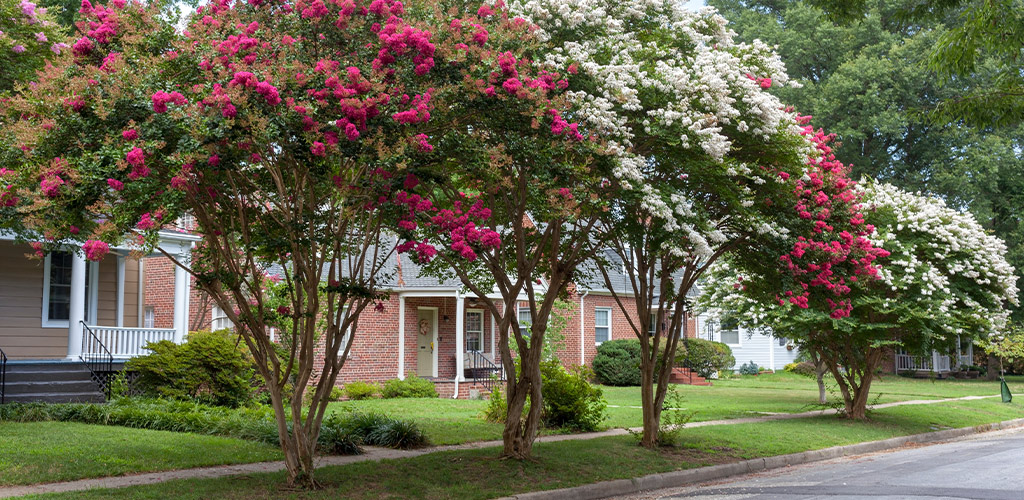
When August saps the energy from most plants, crape myrtles are just getting started. Weeks of bloom, beautiful bark, and reliable structure make them the standout of late-summer Alabama landscapes. From compact shrubs to true tree forms, with colors in whites, corals, pinks, fuchsias, lavenders, and deep reds, there’s a cultivar for every spot.
Why crape myrtles win in late summer
Crape myrtles loves the full sun, heat, and humidity that Alabama dishes out. They carry beds through the hottest stretch, then deliver bonus interest with exfoliating winter bark and, on many varieties, solid fall color. Use them as front-yard focal points, paired entries along a drive, informal screens, or anchors in layered planting beds.
Best time to plant (and why we recommend it)
You can admire crape myrtles any month, but the ideal planting window is late fall through early spring. Cooler air and still-warm soil lower transplant stress and push strong root growth, so the plant is ready to bloom hard next summer. If you’re eager to add one while they’re in flower, we’ll help you select the right cultivar now and reserve a fall installation so you get the size and color you want.
Bloom timing (and how to encourage more)
Most cultivars flower mid-summer into early fall; peak depends on variety, sun, and site. You’ll get the best show with full sun and a light, balanced spring feeding. Skip heavy nitrogen in midsummer, which chases soft foliage at the expense of flowers. On dwarf and semi-dwarf forms, light deadheading after the first flush can encourage a modest re-bloom.
Establishment timeline: sleep, creep, leap
Crape myrtles follow the classic pattern:
- Year 1 — Sleep: roots first; consistent moisture matters more than rapid top growth.
- Year 2 — Creep: canopy fills and bloom count climbs.
- Year 3 — Leap: the form and flower power you pictured.
Stake only on windy, exposed sites, and remove supports after the first season.
Right size, right place (skip the future pruning headache)
Match the mature size to the space so you never need harsh cuts.
- Dwarf (≈2–5′): foundation beds, under windows, mixed borders.
- Semi-dwarf (≈6–12′): framing entries, along fences, driveway pairs.
- Tree form (≈15–25′+): lawn specimens, streetside plantings, anchors in layered beds.
Leave room for the mature width near corners, sidewalks, and rooflines—your future self will thank you.
Pruning options and seasonal care
Timing: Make structural cuts in late winter to very early spring while trees are leafless. Summer work should be light and selective.
Pruning approaches to use:
- Structural training (young trees): Establish a strong central framework, remove crossing or rubbing branches, and set clear scaffold spacing for long-term form.
- Selective thinning (all sizes): Remove a few interior branches at their origin to open the canopy, improve airflow, and showcase bark—without reducing natural height.
- Canopy raising (tree-form cultivars): Remove lower laterals gradually to create pedestrian or driveway clearance while keeping a proportionate crown.
- Renewal pruning (multi-stem shrubs/dwarfs): Take out one to three of the oldest canes at ground level each winter to stimulate fresh, flowering shoots.
- Tip cleanup (dwarf/semi-dwarf): After the first bloom flush, snip spent panicles back to a lateral to encourage a lighter second show.
Good habits: Avoid removing more than 25–30% of live wood in a single year, make clean collar cuts (no stubs or flush cuts), sanitize blades between plants, and step back often to keep the plant’s natural silhouette.
Water & feeding: After establishment, water deeply but infrequently; in drought, one thorough soak beats frequent sprinkles. A light, balanced spring feeding supports bloom; avoid heavy midsummer nitrogen.
Pest watch: Monitor for aphids (sooty mold) and crape myrtle bark scale; early, targeted treatment keeps foliage clean and color bright.
Design notes
Consider bold pinks and reds set against evergreen structure (dwarf yaupon, holly), tree-form crapes layered with loropetalum, daylilies, and liriope for four-season interest, and compact cultivars under windows to preserve light and views.
How Steven’s Wack-N-Sack helps
We match cultivar to site—sun, soil, size, and color—so the plant thrives without constant intervention. We plan installs for the best planting window, handle depth and soil prep correctly, and help set simple watering plans. Need ongoing care? Our team manages seasonal pruning, pest monitoring, and bed refreshes to keep your investment looking its best.
Thinking about a crape myrtle for your landscape? We’ll help you choose the right size and color now and schedule the install at the ideal time. Book a quick design consult with Steven’s Wack-N-Sack and let’s add August-proof color that lasts.